Drive I-35 between Austin and San Antonio in July and you will pass shredded trailer tread on the shoulder every few miles. Almost none of that was bad luck. RV tire failures are one of the few big-ticket RV problems that are close to fully preventable, and the whole prevention routine costs about fifteen minutes and a decent pressure gauge. Here is what actually matters, why Texas summer makes it worse, and what a blowout does to the rest of your rig when it lets go.
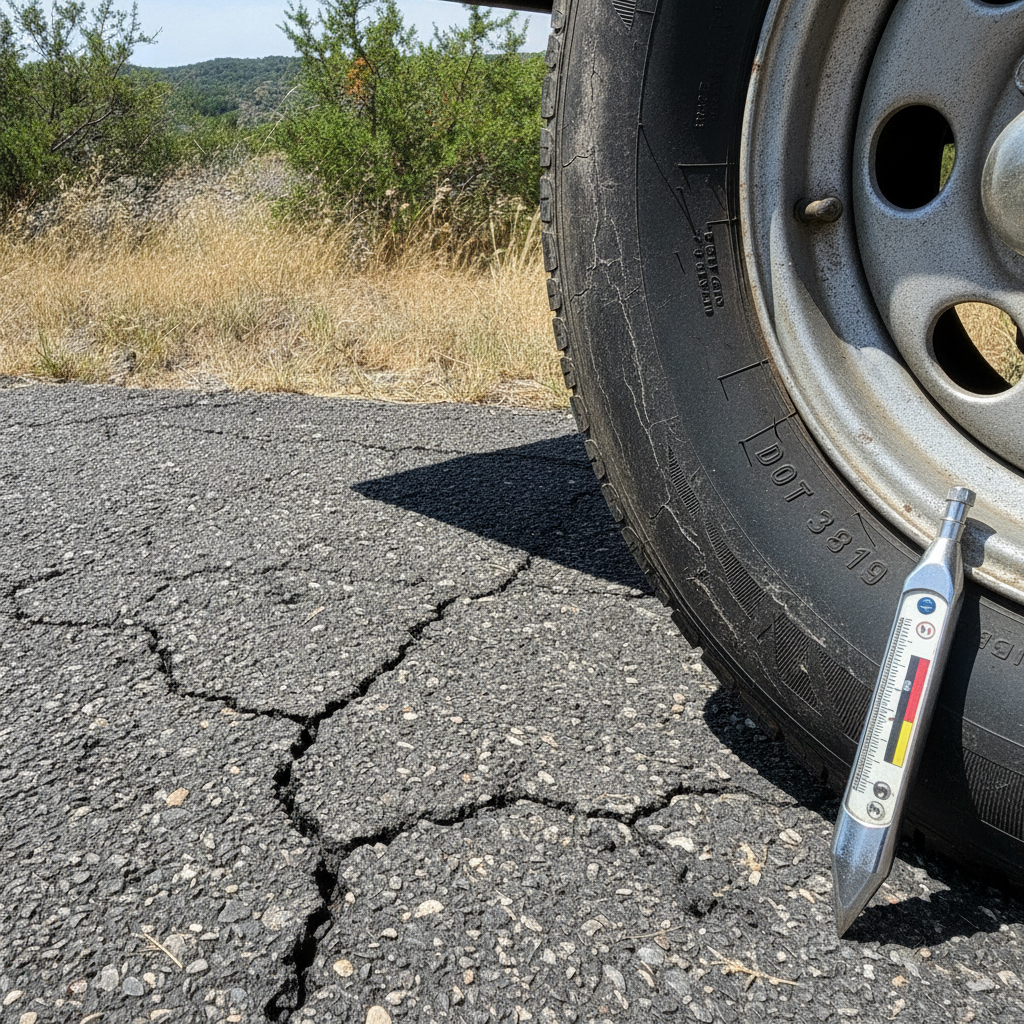
Fine sidewall cracking and a date code worth reading. This tire has plenty of tread left and no business on a highway.
Heat Does Not Cause Blowouts. Heat Plus Low Pressure Does
Texas asphalt in July runs far hotter than the air temperature on your phone. A tire rolling on that surface is already running hot before it does any work. What turns hot into catastrophic is underinflation: an underinflated tire flexes more through the sidewall, and that flexing generates heat internally. The rubber and the steel belts inside separate, and once that separation starts, failure is a matter of miles, not luck.
This is why the single highest-value habit is checking cold pressure before every trip. Not tread depth, not tire brand — pressure. A trailer tire can lose meaningful pressure over a few months of sitting and still look completely normal to the eye, because trailer tires have stiff sidewalls that barely bulge even when they are 15 PSI low.
Setting Pressure Correctly (This Trips Up Almost Everyone)
Three rules, and the third one is the one people get backwards.
- Check cold. Cold means the RV has been sitting for several hours and has not been driven. Pressure read after even a few miles is inflated by heat and will fool you into running low.
- Use the placard number for your loaded weight, not the sidewall maximum. The number molded into the tire is the maximum the tire can hold, not a recommendation. Your target comes from the RV manufacturer placard and the tire load-inflation table for what your rig actually weighs loaded. If you have never weighed your RV loaded for a trip, that is the most useful thing you can do for tire life and safety — and CAT scales at truck stops will do it for a few dollars.
- Never bleed air out of a hot tire. Pressure climbing as you drive is normal and the tire is engineered for it. Letting that air out at a rest stop leaves the tire badly underinflated once it cools, which is exactly the condition that destroys tires.
Tandem axles hide problems. On a dual-axle trailer, one tire going flat quietly transfers its load to the tire in front of or behind it. That overloaded neighbor is then the one that fails, often violently. A tire pressure monitoring system is the only practical way to know about a slow leak while you are moving.
RV Tires Age Out Before They Wear Out
This is the part that surprises owners with low-mileage rigs. Your travel trailer probably spends 340 days a year parked. All of that time, UV and heat are breaking down the rubber compound from the outside in, and the tire is doing it standing still. Plenty of RV tires that fail have well over half their tread remaining.
The industry guidance is replacement at five to seven years from the manufacture date. In Central Texas, plan on the low end of that. Read the date from the DOT stamp on the sidewall: the last four digits are week and year, so 3819 is the 38th week of 2019. Note that on many tires the complete DOT code is only stamped on one side, so if you cannot find it, look at the inboard face.
Two cheap habits that meaningfully extend tire life while parked: cover the tires so they are out of direct sun, and move the rig a few feet every month or two so the same patch of sidewall is not permanently loaded and flat-spotted.
Your Fifteen-Minute Pre-Trip Tire Check
Do this the evening before you leave, while the tires are cold and you still have time to fix what you find.
- 1
Cold pressure on every tire, including the spare. Check before you drive, not at the gas station 20 miles down the road. A spare that has been sitting at 20 PSI for two years is not a spare, it is a decoration.
- 2
The DOT date code. Last four digits of the DOT stamp: week, then year. 3819 is the 38th week of 2019. If those tires are past five years old, tread depth is no longer the deciding factor.
- 3
Sidewall cracking. Fine spiderweb cracks in the sidewall or between the tread blocks mean UV and heat have degraded the rubber. Deep cracks mean the tire is done, whatever the tread looks like.
- 4
Uneven or cupped wear. Wear on one shoulder points at an alignment or bent axle issue. Center wear means chronic overinflation, edge wear on both sides means chronic underinflation. The wear pattern tells you what has been going wrong.
- 5
Valve stems and caps. Rubber valve stems dry-rot and crack in Texas sun exactly like sealant does. They are a few dollars and a common slow-leak source. Metal caps with a seal beat plastic ones.
- 6
Lug nut torque. Check with a torque wrench to your rig spec after any wheel comes off, and again after the first 50 miles. Loose lugs destroy wheel studs and can shear them on the highway.
Speed Matters More Than People Think
Most ST-rated trailer tires are speed rated to 65 mph, and many are rated for that only at their proper cold pressure and load. Texas highways post 75 and 80. Running a 65 mph tire at 78 mph on 105-degree pavement is not a small margin call — it is the single most common set of conditions behind the tread you see on the shoulder. If your tires carry a higher speed rating, run what they are rated for. If you do not know what they are rated for, 65 is the safe assumption.
Heat also builds with time at speed, not just speed itself. On a long haul across the Hill Country in August, stopping every couple of hours genuinely helps.
If One Lets Go While You Are Driving
The instinct is to brake hard. That is the wrong move and it is what turns a blowout into a jackknife. Grip the wheel firmly with both hands, hold your lane, and if anything, ease into the throttle briefly to pull the rig straight before you slow down gradually and coast well off the shoulder. Get everyone out on the side away from traffic before you look at anything.
The Tire Is the Cheap Part
A trailer tire that comes apart at 70 mph does not fail quietly. The tread separates into a heavy strap of rubber and steel and beats the underside of your rig at road speed. What we typically get called out to fix afterward:
- Fender skirt torn off or cracked beyond repair
- Coroplast underbelly shredded, exposing insulation and plumbing
- Fresh water and drain lines cut by flying tread
- Tank valves and dump piping knocked loose
- Wiring harness for brakes and running lights ripped out
- Lower sidewall, slide trim, and skirting metal punched through
A new tire is a modest expense. Replacing an underbelly, repairing cut water lines, and rebuilding a fender and wiring run is a different conversation entirely. And unlike the tire, that damage cannot be handled at a tire shop.
When to Bring in a Tech
Pressure checks, valve caps, and reading date codes are entirely DIY. Bring someone in when you find uneven wear that suggests an axle or alignment problem, when you have had a blowout and need the underbelly, plumbing, wiring, or fender put back right, when your brakes are dragging or grabbing on one side, or when the bearings have not been repacked in years and you are about to tow across the state.
Blowout repair is well suited to mobile service — the work happens wherever the rig is sitting, whether that is your driveway, a storage lot, or the campground you limped into. Impact RV Repair covers Kyle and everywhere within 50 miles, including Buda, Austin, San Marcos, New Braunfels, Canyon Lake, Dripping Springs, and Wimberley.
Had a Blowout? Get the Rest of the Rig Put Back Right
Underbelly, plumbing, wiring, fenders, and skirting — the damage a blown tire leaves behind gets repaired on site. Call Impact RV Repair at 512-968-5258 anywhere in the Kyle and Austin area.
Related Reading
Serving Kyle, Buda, Austin, San Marcos, New Braunfels, Canyon Lake, and Central Texas within 50 miles of Kyle with on-site RV repair and maintenance. Mon–Sat, 8am–6pm · 512-968-5258