
August is when RV electrical systems get tested hardest in Central Texas. Air conditioners run around the clock, campground parks are full, and the local grid is under real strain — which means the power arriving at your pedestal is not always the power you are supposed to be getting. Most of what we get called out for in late summer falls into four buckets, and two of them you can sort out yourself in five minutes. The other two are worth understanding before they cost you a compressor.
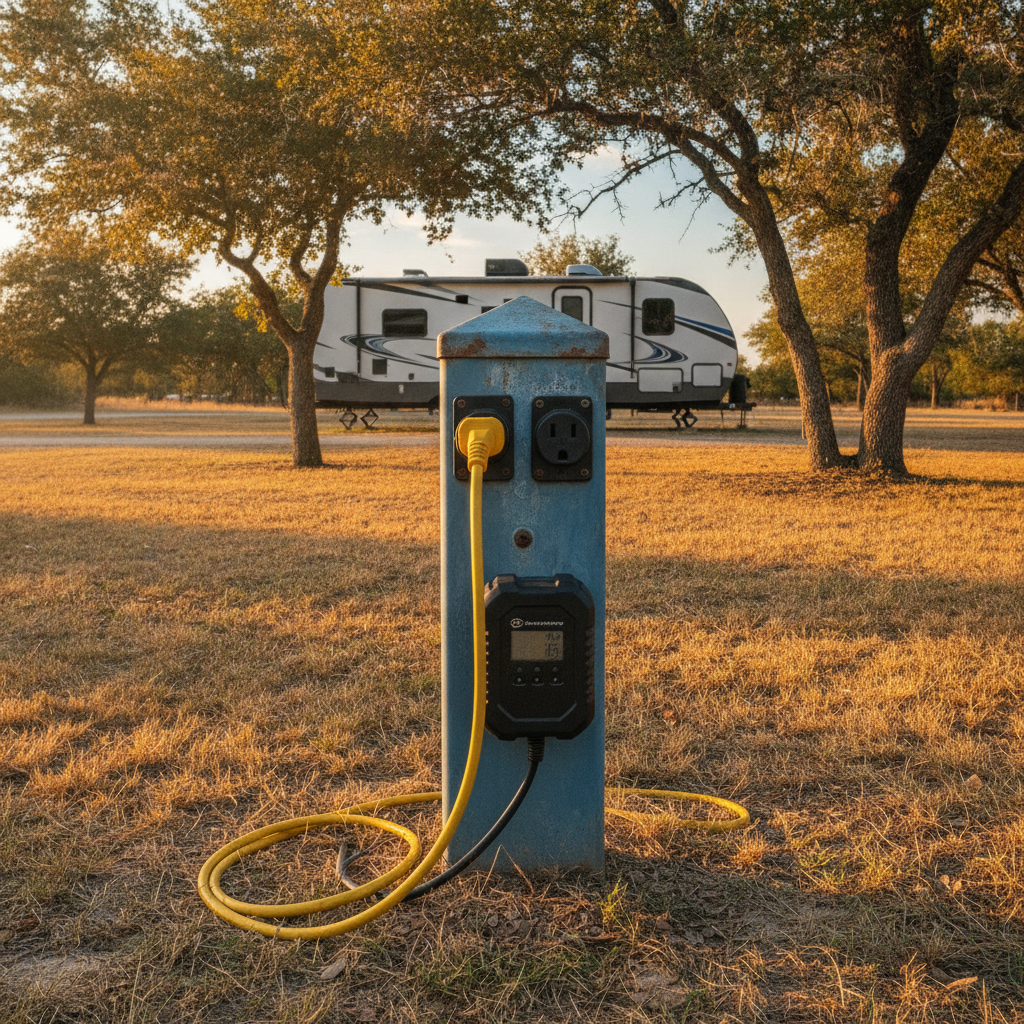
Everything your RV electrical system experiences starts here. An EMS at the pedestal is the cheapest insurance in RVing.
First, Know What Service You Actually Have
Almost every summer electrical complaint makes sense once you know your ceiling. A 30 amp RV service is a single 120-volt leg — about 3,600 watts total for the entire rig. A 50 amp service is two 120-volt legs at 50 amps each, roughly 12,000 watts. That is not “a bit more power,” it is more than three times as much, which is why 50 amp rigs run two air conditioners and 30 amp rigs do not.
The other thing worth knowing: plugging a 50 amp rig into a 30 amp pedestal with an adapter does not give you 50 amps. You still only have 3,600 watts, now split across a panel designed to expect far more. The adapter is legitimate; the expectation is what breaks.
Problem One: The Breaker Keeps Tripping
If the main breaker at the pedestal trips, it is almost always a load problem, not a fault. Here is roughly what your appliances cost you on a 30 amp budget, so you can do the math in your head instead of guessing:
- 1
Rooftop air conditioner: roughly 12–16 amps running. On a 30 amp service that is half your capacity, and the startup surge is briefly much higher. A second rooftop unit is simply not possible on 30 amp service without load management.
- 2
Electric water heater element: roughly 12 amps. Easy to forget because there is no noise and no display. Switch it to propane when you are close to the limit and you free up a large chunk of the budget instantly.
- 3
Microwave: roughly 12–13 amps. Short duration but a big spike. Running the microwave while the air conditioner cycles on is the classic trip.
- 4
Hair dryer or space heater: roughly 12–15 amps. The most common trip cause of all, because it gets plugged into a bedroom outlet with no thought about what else is running.
- 5
Coffee maker, toaster, instant pot: roughly 8–12 amps each. Individually fine, but breakfast is when three of them run at once.
- 6
Converter, fridge on electric, lights, fans: 5–10 amps combined. Your baseline load. It is always running in the background and it is what makes the last appliance the one that trips the breaker.
The practical rule on 30 amp in August: the air conditioner gets priority, the water heater runs on propane, and you use one high-draw kitchen appliance at a time. That alone solves the majority of tripping complaints.
A breaker that trips instantly with almost nothing running is a different animal — that points at a short or a failing appliance, and repeatedly resetting it is not a fix.
Problem Two: Half the Outlets Went Dead
This one panics people and it is usually free to fix. In most RVs, a string of outlets is wired downstream of a single GFCI outlet — commonly in the bathroom, sometimes behind a cabinet or under the sink. When that GFCI trips, every outlet fed from it goes dead, and the breaker panel still looks completely normal because no breaker actually tripped.
Find the GFCI, press reset, and the rest usually wake up. Worth doing now rather than in the dark: locate yours and remember where it is. Exterior outlets and the outlet behind the fridge are frequently on that same circuit, which is why a wet exterior outlet after a Hill Country downpour kills your bedroom nightstand.
A GFCI that will not stay reset is telling you something. It is detecting current leaking to ground, which is the condition that shocks people. Unplug everything on the circuit and try once more. If it still refuses, stop resetting it and get it diagnosed.
Problem Three: Low Voltage, the Expensive One
This is the problem that costs real money and it produces no obvious symptom until something is already damaged. On a full park in August, with every rig running air conditioning, pedestal voltage sags. Long or undersized park wiring makes it worse. You may be receiving 103 volts when you think you are receiving 120.
Here is why that matters: a motor draws more current when voltage drops, because it still has the same work to do. Higher current means more heat in the windings. Sustained operation below roughly 105 volts is how air conditioner compressors, converters, and residential fridge compressors get cooked — slowly, invisibly, and then all at once. Owners almost always blame the appliance. The appliance was fine.
Dimming lights every time the air conditioner starts is your free early warning that the supply is weak. So is an air conditioner that struggles at one park and works fine at another. If you want to see the whole picture on why an AC underperforms, our guide to RV AC not cooling in Texas heat covers the mechanical side of the same complaint.
Surge Protector vs. EMS: Buy the Right One
These get used interchangeably and they are not the same product. A basic surge protector defends against a voltage spike — a lightning event or a park fault. Useful, but spikes are not what damages most RVs.
An electrical management system monitors continuously and disconnects your rig automatically on low voltage, high voltage, open ground, reverse polarity, and miswired pedestals. It is the one that actually prevents the failure described above. If you are choosing between them for Texas summer camping, the EMS is not a luxury — it costs a fraction of one air conditioner replacement and it is the only thing standing between your rig and whatever the pedestal decides to deliver.
Plug it in at the pedestal and check its voltage readout when you arrive and again in the late afternoon when park demand peaks. Those two numbers tell you a great deal about where you are staying.
Problem Four: Heat at the Connection
A loose or corroded connection carrying 30 amps generates heat right at that point, and heat makes the connection worse, which makes more heat. This is the failure mode that starts fires, and it announces itself clearly if you look. Check for these every time you connect:
- Browned, blackened, or pitted prongs on your shore power plug
- A plug or adapter that is hot to the touch after an hour of use
- A melted or deformed edge on the pedestal outlet or dogbone adapter
- A burning or hot-plastic smell near the power inlet
- Lights that dim noticeably every time the air conditioner starts
- A pedestal outlet that feels loose when you plug in
Two habits worth adopting: turn the pedestal breaker off before plugging in or unplugging, so you are not making the connection under load, and stop using household extension cords for shore power. An undersized cord drops voltage across its own length and turns into a heater. If you need reach, use a properly rated RV extension in the correct gauge.
Do Not Forget the 12-Volt Side
Your lights, water pump, fans, furnace board, and slide motors all run on 12 volts, fed by the converter when you are plugged in. If interior lights are dim or flickering, the pump runs weak, or the battery keeps going flat while you are on shore power, the converter is a prime suspect — and Texas heat is hard on converters, especially the ones mounted in unventilated compartments.
Also check the battery terminals for corrosion and make sure they are tight. A loose or corroded terminal produces symptoms that look exactly like a dying battery, and it costs nothing to rule out.
What Is Safe to DIY, and What Is Not
Reasonable to handle yourself: resetting a GFCI, managing your load, checking and cleaning battery terminals, inspecting your shore cord and adapters, and installing an EMS at the pedestal.
Call someone for the rest. Anything that involves opening the 120-volt breaker panel, tracing a circuit that keeps faulting, a converter that is not charging, a breaker that trips with no load, a burned plug or inlet, or an air conditioner that has been running on weak power and is now behaving oddly. RV wiring combines 120-volt AC and 12-volt DC in tight spaces, and the 120-volt side is genuinely dangerous to guess at.
Electrical diagnosis is well suited to mobile service, because the problem often only shows up at the site where the RV is actually plugged in. Impact RV Repair covers Kyle and everywhere within 50 miles, including Buda, Austin, San Marcos, New Braunfels, Canyon Lake, Dripping Springs, and Wimberley.
Electrical Gremlins? Get It Diagnosed Where It Happens
Tripping breakers, dead circuits, converters that will not charge, and heat-damaged shore power connections — diagnosed and repaired on site. Call Impact RV Repair at 512-968-5258 anywhere in the Kyle and Austin area.
Related Reading
Serving Kyle, Buda, Austin, San Marcos, New Braunfels, Canyon Lake, and Central Texas within 50 miles of Kyle with on-site RV repair and maintenance. Mon–Sat, 8am–6pm · 512-968-5258